Unifi Controller Login
Configuring the Unifi controller
UniFi Poller supports three ways to authenticate to your UniFi environment. Pick the one that matches your setup:
- Local controller account - a username/password for a Limited Admin user on the controller. Works with every controller type. This is the method documented below and used throughout the rest of these docs.
- Local API key - an API key generated directly on newer UnifiOS controllers (Network
Server version dependent), used in place of a username/password. Set
api_keyinstead ofuser/passon the controller. This avoids storing a password, but is only available on controllers new enough to support API key generation in their UI. - Remote API key - an API key generated from your Ubiquiti (UI) account, used when UniFi Poller cannot reach the controller directly (for example, it runs on a different network than the controller). See Application Configuration for how to configure this method.
The rest of this page covers the local controller account method.
The only requirement of the controller is that UniFi Poller can log in to it and extract data. For this purpose go ahead and create a new user. Make a note of the username and password you have chosen.
Adding a user depends on the type of controller you have.
UnifiOS Controller
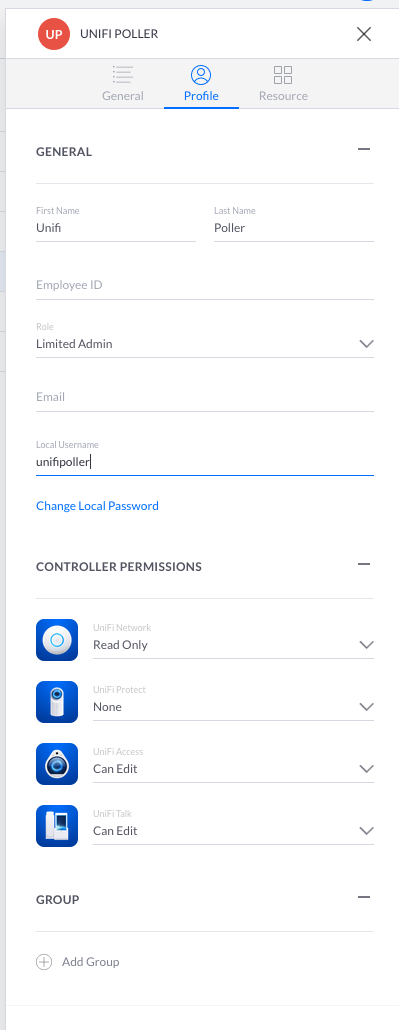
UnifiOS is Ubiquiti's underlying OS/Network Server, not a specific device model - it runs on UDM, UDM Pro, UDM SE, UDM Pro Max, UXG, UXG Pro, UXG Lite, UCG (Cloud Gateway) Ultra/Max/Fiber, UCK G2/G2 Plus, and self-hosted UnifiOS Network Server installs. If your controller runs UnifiOS (check under Settings > System in the UniFi Network app), it is recommended that a Limited Admin user is created with Read-Only rights to the UniFi Network app. Other access levels may not work correctly.
For example, the screenshot below shows the username chosen as unifipoller.
This is the default, and will be used throughout these docs.
Non UnifiOS Controller
If you are using another controller type (eg. Cloudkey Gen1 or a software controller not running UnifiOS) then create a manual read-only user.
The Email field will be the 'username' you will need to create the config file.
The UniFi controller currently requires the email be formatted correctly. If you don't have
your own domain try using @example.com so you don't inadvertently give access to a random user.